


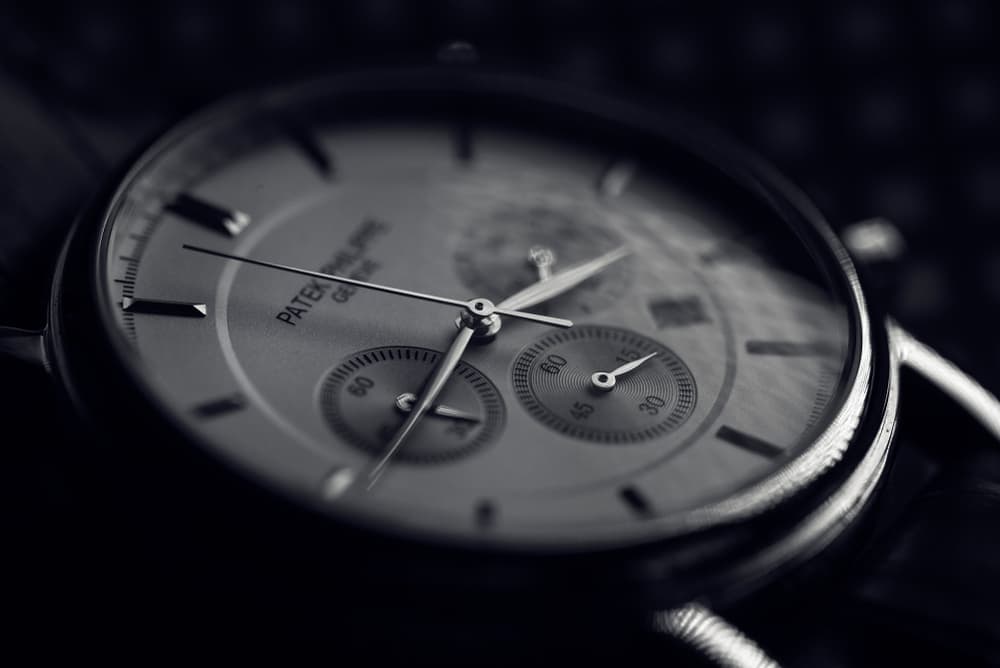

In January 18, 2021, Patek Philippe president Thierry Stern dropped a bombshell: the stainless steel Nautilus ref. 5711/1A would be discontinued. Within 72 hours, secondary market prices surged 49%. A watch that traded at $95,000 pre-announcement vaulted past $140,000. By mid-2022, examples fetched $250,000 seven times retail.
This wasn’t rational market behaviour. It was collective panic-the horological equivalent of watching a masterpiece leave the museum forever. The 5711’s discontinuation transformed it from a luxury sports watch into a finite cultural artifact. And in that moment, the Nautilus/Aquanaut debate ceased being about aesthetics. It became a referendum on what collectors truly value: historical immortality versus contemporary relevance.
Nautilus vs Aquanaut Size Comparison
On paper, both the Patek Philippe Nautilus and Aquanaut wear 40mm cases. In reality, size perception diverges dramatically due to case architecture:
| Measurement | Nautilus (Ref. 5711/5811) | Aquanaut (Ref. 5167/5168) |
|---|---|---|
| Case Diameter | 40mm | 40.5mm (5167) / 42.2mm (5168) |
| Wing-to-Wing Width | 43mm (due to protruding “ears”) | 41mm (smooth contour) |
| Lug-to-Lug | 44mm | 49.5mm (longer lugs stretch presence) |
| Case Thickness | 8.3mm | 8.1mm (technically slimmer) |
| Wrist Presence | Bold but elegant | Sportier, more substantial |
The collector insight: Despite identical nominal sizing, the Nautilus wears smaller due to its integrated “ears” that hug the wrist. The Aquanaut’s longer lug-to-lug measurement creates a more assertive footprint especially on wrists under 6.75 inches. This isn’t academic: collectors with slender wrists consistently choose the Nautilus for proportionality, while broader-wristed owners favor the Aquanaut’s modern stance.
Nautilus Case Design vs Aquanaut Case Architecture
The Nautilus Hinged Case:
The Patek Phillip Nautilus doesn’t just look like a ship’s porthole it functions as one. Its caseback screws into a monocoque middle section, while the bezel attaches via two signature “ears” (or “tabs”) at 3 and 9 o’clock. These aren’t decorative they’re functional hinges that compress the crystal against the case under pressure, achieving 120m water resistance without a screw-down crown.
- Bezel Geometry: Sharp octagonal with pronounced facets catching light at precise angles
- Surface Finishing: Alternating polished bevels and vertical satin brushing (55 hand-finishing operations per bracelet link)
- Historical Weight: Direct descendant of Gérald Genta’s 1976 ref. 3700—the watch that made steel precious
The Aquanaut Integrated Case:
Launched in 1997 as Patek’s “contemporary sports watch,” the Aquanaut abandoned the hinged architecture for a more conventional three-part case construction. No functional ears just sculptural curves flowing into the lugs.
- Bezel Geometry: Softer octagon with rounded corners; less aggressive light play
- Surface Finishing: Uniform satin brushing with subtle polished accents
- Design Philosophy: Not a reinterpretation of the Nautilus—but a rejection of its formality. The Aquanaut’s case was engineered for the rubber strap from inception.
Collector verdict: Nautilus owners fetishize the hinged case as horological theater. Aquanaut collectors dismiss it as “unnecessary watch complication“preferring the Aquanaut’s honest, tool-watch ethos.
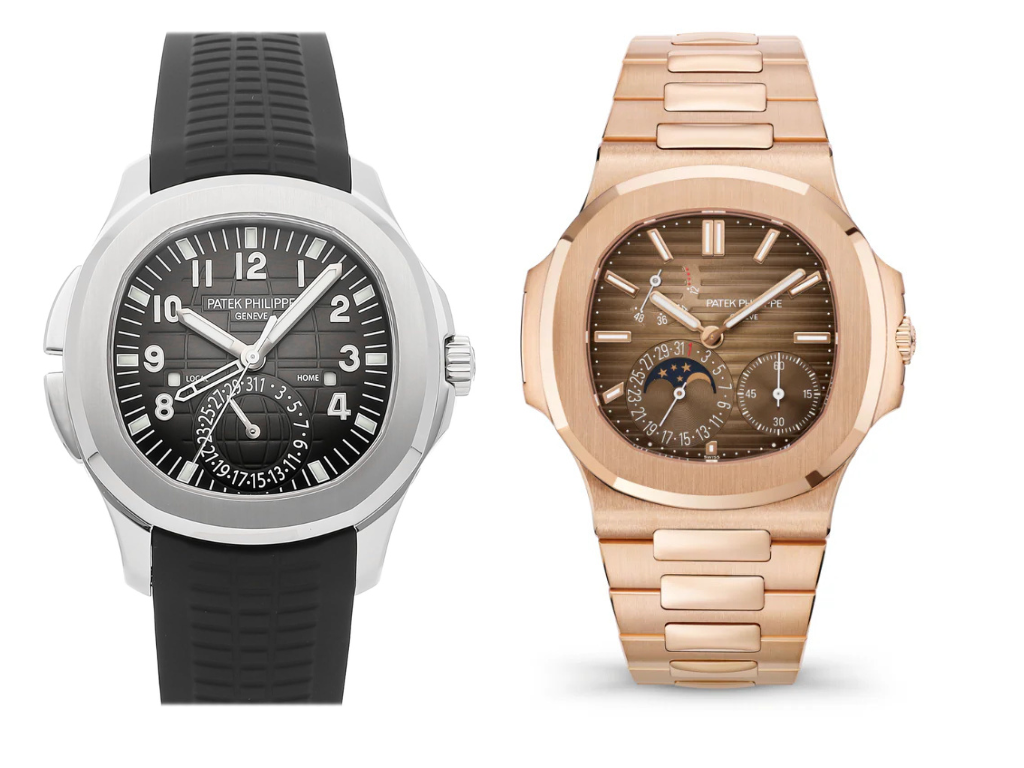
Nautilus Bracelet vs Aquanaut Strap
Nautilus Metal Bracelet:
Every Nautilus bracelet undergoes 55 distinct hand-finishing operations before leaving Patek’s Geneva ateliers:
- Center links: Mirror-polished by hand using progressively finer abrasives
- Outer links: Vertical satin brushing applied with horsehair brushes
- Clasp integration: Seamless transition mimicking case contour
- Flexibility: 18 articulation points allowing the bracelet to drape like fabric
Critical detail: The bracelet’s weight distribution creates a “floating” sensation—many collectors describe it as “disappearing on the wrist” despite its substantial presence.
Aquanaut Composite Strap:
The Patek Phillip Aquanaut signature “tropical” strap isn’t rubber—it’s a proprietary composite polymer engineered exclusively for Patek Philippe:
- UV resistance: Won’t degrade or discolor after years of sun exposure
- Saltwater immunity: Molecular structure repels corrosion (tested in Mediterranean seawater for 500+ hours)
- Thermal stability: Remains supple from -20°C to +60°C
- Integrated design: Strap flows directly from case without spring bars creating visual continuity
Early Aquanauts (1997–2006) were ridiculed for the “cheap-looking” strap. Today, that same strap material is the ultimate filter signaling you value engineering over ornamentation. The 2021 introduction of a metal bracelet option (ref. 5167/1R) diluted this purity, causing purists to seek earlier rubber-strap references.
Wearability truth: Nautilus integrated bracelet owners rarely remove their watch. Aquanaut strap owners swap between rubber and metal depending on occasion proving the strap’s versatility was always the point.
Nautilus Movement vs Aquanaut Caliber
Contrary to popular belief, modern Nautilus and Aquanaut models share identical movements:
| Specification | Nautilus (Ref. 5811/1G) | Aquanaut (Ref. 5167A-001) |
|---|---|---|
| Caliber | 26-330 S C | 26-330 S C |
| Frequency | 28,800 vph (4Hz) | 28,800 vph (4Hz) |
| Power Reserve | 45 hours | 45 hours |
| Finishing | Geneva Seal (entire movement) | Geneva Seal (entire movement) |
| Rotor Material | 21K gold | 21K gold |
| Functions | Hours, minutes, seconds, date | Hours, minutes, seconds, date |
The source article’s reference to quartz movements applies only to vintage ladies’ models (e.g., Nautilus 7010, Aquanaut 5067)—not contemporary men’s sports watches. Since 2006, all standard-production Nautilus and Aquanaut references have been mechanical-only. Patek Philippe discontinued quartz movements in its luxury sports lines precisely to reinforce their horological legitimacy.
The collector reality: Movement differentiation exists only in complications:
- Nautilus 5712/1A: Caliber 240 PS IRM C LU (moonphase + power reserve)
- Aquanaut 5650G: Caliber 324 S C FUS (travel time with local day/night)
For base models? Identical engineering. The choice isn’t about mechanics it’s about aesthetics as identity.
Nautilus Price vs Aquanaut Value
Retail Pricing (Official Patek Philippe List)
| Model | Retail Price (USD) | Production Status |
|---|---|---|
| Nautilus 5711/1A (discontinued) | $34,890 (2021) | Ceased production Jan 2021 |
| Nautilus 5811/1G (white gold) | $75,320 | Current production |
| Aquanaut 5167A-001 (steel) | $25,958 | Current production |
| Aquanaut 5168G (white gold) | $47,600 | Current production |
Secondary Market Reality (Q1 2026)
| Model | Current Market Price | Premium Over Retail | 5-Year Appreciation |
|---|---|---|---|
| Nautilus 5711/1A | $132,000 | +278% | +70% (from $77k in 2021) |
| Nautilus 5811/1G | $220,000 | +192% | N/A (new model) |
| Aquanaut 5167A-001 | $78,500 | +202% | +81% (from $43k in 2021) |
| Aquanaut 5968A (chronograph) | $115,000 | +245% | +94% |
The allocation truth no one admits:
- Nautilus access: Requires $250,000+ annual spend on non-sports Pateks for 3–5 years at a single AD
- Aquanaut access: Requires $120,000+ spend—but ADs increasingly bundle it with a precious-metal purchase (e.g., $50k Calatrava)
- The myth of “affordability”: While the Aquanaut’s retail price is 26% lower than the discontinued Nautilus, its secondary market premium is only 15% lower. You’re not saving meaningful capital—you’re choosing a different status signal.
Collector behavior pattern: Those who secure retail Aquanauts typically keep them. Those who secure retail Nautiluses often flip them immediately for 3–4x profit revealing the Nautilus’s role as asset versus the Aquanaut’s role as tool.
The Verdict: Which Do Collectors Actually Prefer?
Let’s cut through the marketing:
For pure investment/speculation: Neither. Both corrected 40%+ from 2022 peaks. The era of guaranteed appreciation is over.
For historical significance: Nautilus—but only discontinued references. A new 5811 lacks the 5711’s mythic weight. Collectors chasing legacy want the “last of its kind,” not the successor.
For daily wear with conviction: Aquanaut. The rubber strap isn’t a compromise—it’s a statement. Collectors who wear Aquanauts on strap (not bracelet) signal they’ve moved beyond needing metal to validate status.
The collector’s truth no one admits: Most serious Patek collectors own both—but the Nautilus lives in the safe for “important” occasions, while the Aquanaut lives on wrist. The Nautilus is the trophy; the Aquanaut is the tool. One validates your past; the other enables your present.
The most sophisticated Patek owners don’t choose. They acquire a discontinued Nautilus 5711 as a store of value then wear an Aquanaut 5167 daily without apology. They understand that in modern luxury, investment watches and identity must be separated. One secures your place in horological history. The other enables your life today.

Leave a Comment