


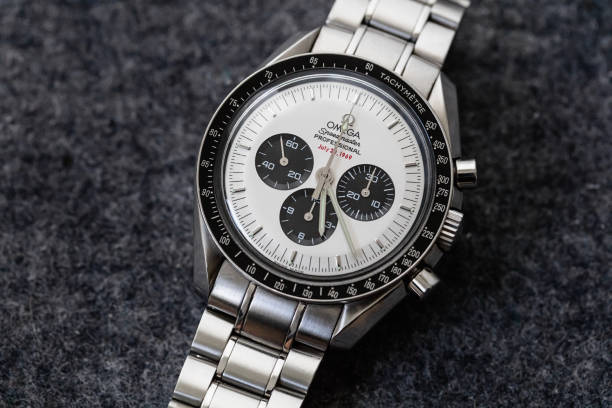

When Neil Armstrong and Buzz Aldrin stepped onto the lunar surface on July 20, 1969, they carried with them not only the hopes of humanity but also a piece of horological history: the Omega Speedmaster. Often hailed as the “first watch on the Moon,” this iconic timepiece has transcended its functional roots to become a symbol of precision, courage, and space-age innovation. In this article, we explore the remarkable journey of the Omega Speedmaster Moon, its pivotal role in NASA’s historic Apollo missions, and why it continues to captivate watch enthusiasts and collectors worldwide.
The Birth of a Legend: History of Omega Speedmaster
Launched in 1957 as part of Omega’s professional chronograph line, the Speedmaster was originally designed for motorsports and aviation professionals. With its sleek black dial, tachymeter bezel, and robust manual-winding movement (Calibre 321, later replaced by Calibre 861), it quickly gained a reputation for reliability and legibility.
But fate had a far more cosmic destiny in store.
In the early 1960s, as the U.S. and Soviet Union raced to dominate space exploration, NASA began rigorously testing wristwatches for use in manned spaceflight. In 1964, the agency submitted several models—including those from Rolex, Breitling, and Omega– to a battery of extreme tests simulating space conditions: high and low temperatures, vacuum, humidity, shock, and vibration.
Only one watch passed them all: the Omega Speedmaster.
In 1965, NASA officially certified the Speedmaster as “flight-qualified for all manned space missions.” This endorsement set the stage for its legendary status.
The First Watch on the Moon Omega: A Moment That Changed History
During the Apollo 11 mission in 1969, Buzz Aldrin wore his Omega Speedmaster on the lunar surface, making it the first watch on the Moon. (Neil Armstrong left his inside the Eagle module as a backup, in case the spacecraft’s electronic timer failed.)
This singular event cemented the Speedmaster’s place in history. Dubbed the “Moonwatch,” it became the only piece of private equipment certified by NASA for extravehicular activity (EVA)—a distinction it still holds today.
The Omega Speedmaster first watch on the Moon wasn’t just a tool; it was a testament to human ingenuity. Built without quartz or digital components, it ticked reliably in the harsh vacuum of space, withstanding temperatures from -18°C to +93°C and zero atmospheric pressure.
Why the Speedmaster Stands Alone: 2,400 Hours of Testing and Beyond
Many wonder: What made the Speedmaster NASA’s choice? Beyond its clean design and Swiss precision, it underwent more than 2,400 hours of rigorous testing during its qualification phase. Every component—from the lubricants to the crystal—was scrutinized for performance under stress.
Even after Apollo 11, the Speedmaster proved indispensable. During the ill-fated Apollo 13 mission in 1970, astronauts used their Speedmasters to time a critical 14-second engine burn that corrected their trajectory back to Earth—a maneuver that saved their lives. For this heroic role, Omega received the prestigious Silver Snoopy Award from NASA.
From Moon Landings to Modern Masterpieces
While the Moon landing may be its crowning achievement, the Speedmaster’s legacy extends far beyond 1969:
- Apollo 13 (1970): When an oxygen tank exploded, the crew used the Speedmaster to time a critical 14-second engine burn that saved their lives. Omega later received NASA’s Snoopy Award—a rare honor for civilian contributions to spaceflight.
- Skylab and Space Shuttle missions: The Speedmaster remained NASA’s trusted companion well into the 1990s.
- Modern spaceflight: Though digital backups exist, the Speedmaster is still part of every astronaut’s kit aboard the International Space Station.
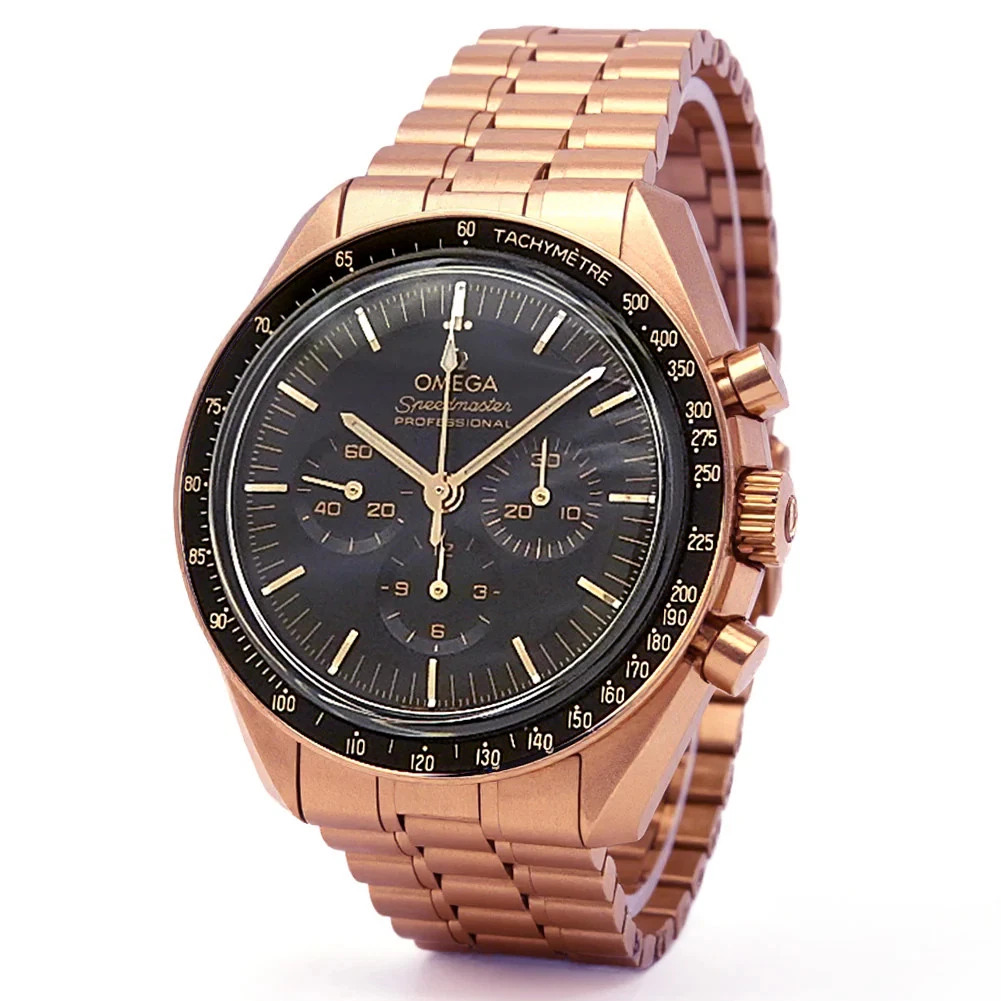
Omega continues to honor its heritage with special editions like the Apollo 11 50th Anniversary, Silver Snoopy Award, and Dark Side of the Moon collections—blending nostalgia with cutting-edge innovation.
The Omega Speedmaster Moon Today: A Timeless Icon
More than half a century later, the Omega Speedmaster Moon remains virtually unchanged in its core design. Current models, like the Speedmaster Professional “Moonwatch,” still feature the same case dimensions, hesalite crystal, and hand-wound watch movement (now the updated Calibre 3861 with Master Chronometer certification).
Its legacy is honored through limited editions, space-themed collaborations, and continued use by astronauts on the International Space Station. Omega has also embraced modern advancements while preserving its heritage- ensuring the first watch on the Moon Omega remains as relevant today as it was in 1969 and one of the best Omega watches.
The Anatomy of an Icon
What makes the Speedmaster so special? Beyond its spacefaring credentials, its design is a masterclass in functional elegance:
- Manual-winding movement: Originally powered by the legendary Calibre 321, later the Calibre 861, and now the modern Calibre 3861 (with Master Chronometer certification).
- Asymmetrical case: Offers extra protection to the chronograph watch pushers.
- Tachymeter bezel: Allows pilots and astronauts to calculate speed based on time traveled over a known distance.
- Hesalite crystal: Chosen by NASA for its shatter-resistant properties, though sapphire options are now available.
Its clean black dial, luminous hands, and triple-register layout have remained largely unchanged since 1957- proving that great design truly stands the test of time (and space).
Final Thoughts: More Than a Watch—A Cultural Artifact
The history of Omega Speedmaster is not just a story of engineering excellence—it’s a narrative woven into the fabric of human exploration. From racetracks to the surface of the Moon, the Speedmaster has proven that true innovation endures.
Whether you’re a space enthusiast, a watch collector, or simply inspired by stories of courage and precision, the Omega watches stands as a reminder that sometimes, the smallest instruments enable the greatest leaps for mankind.
Ready to discover the watch that redefined exploration? Explore our curated collection of iconic timepieces at TimeLuxury and find your own piece of history today. Elevate your style—start your journey with the Speedmaster legacy now.
Leave a Comment